



Disease Overview
bladdercarcinomaisurinarysystemthe most commonmalignant tumorone of,accounting forallmalignant tumorof3%-4%,malesincidenceapproximatelyasfemalesof3-4times。peak age of onset50-70years old, UrbanincidencehighinRural areas.bladdercarcinomabased ontumoris否invasionmuscular layerclassified intonon-muscular layerinvasiontypebladdercarcinoma(NMIBC,accounting for75%)andmuscular layerinvasiontypebladdercarcinoma(MIBC,accounting for25%)。NMIBCprognosisrelativelygood,5yearsurvival ratecan达80%-90%;MIBCrelatively poor prognosis,5yearsurvival rateapproximately50%-60%。hematuriaisthe most commoninitialsymptoms,accounting for80%-90%patientsofinitialmanifestation。
Major Causes
Smoking:most importantofrisk factor,approximately50%bladdercarcinomapatientshaveSmokingHistory,increased risk2-3times。
Occupational exposure:long-termExposure to aromaticamineclasscombine(Dyes, rubber, leather, aluminum productsetc.)increasingrisk,approximately20%andOccupationalhaveclose。
chronic inflammatory stimulation:bladderstones、chronicbladderInflammation,long-termIndwelling urinary catheter, Schistosomadiseaseetc.。
drugdue toelement:long-term服usingcyclophosphamidechemotherapy, Abuse ofusingphenacetin、enablingusingDiabetesdrugpioglitazone。
Other factors:High-fat diet, Low water intake,family history、genetictypebladdercarcinoma(rare)。
Common Symptoms
hematuria:the most commoninitialsymptoms,80%-90%patientsappearing,typicallyno痛type、intermittent、entire process肉eyehematuria。
bladderstimulationsign:urinary frequency、urinary urgency、dysuria,approximately10%patientsmanifestationasinitialsymptoms。
dysuria:Tumor invadesbladder颈orprostatecausingUrinationobstruction。
abdominal pain、lumbarpain:advanced-stageorappearingupperUrinary tractobstruction、renalHydronephrosistime。
othersymptoms:body weightunderdecrease、fatigue、food欲decreaseretreat、advanced-stageappearingcachexia。
Classification and Staging
Pathological Classification
urothelial carcinoma(accounting for90%-95%):transitional cell carcinomamostcommon,squamous cell carcinoma、glandularcarcinomarare。
squamous cell carcinoma(3%-7%):normalandSchistosomadisease、chronic inflammationrelated。
glandularcarcinoma(<2%):more源inUrachal remnants.
othertype:small cell carcinoma、neuroendocrine tumorsetc.。
TNM Staging(AJCC8th edition)
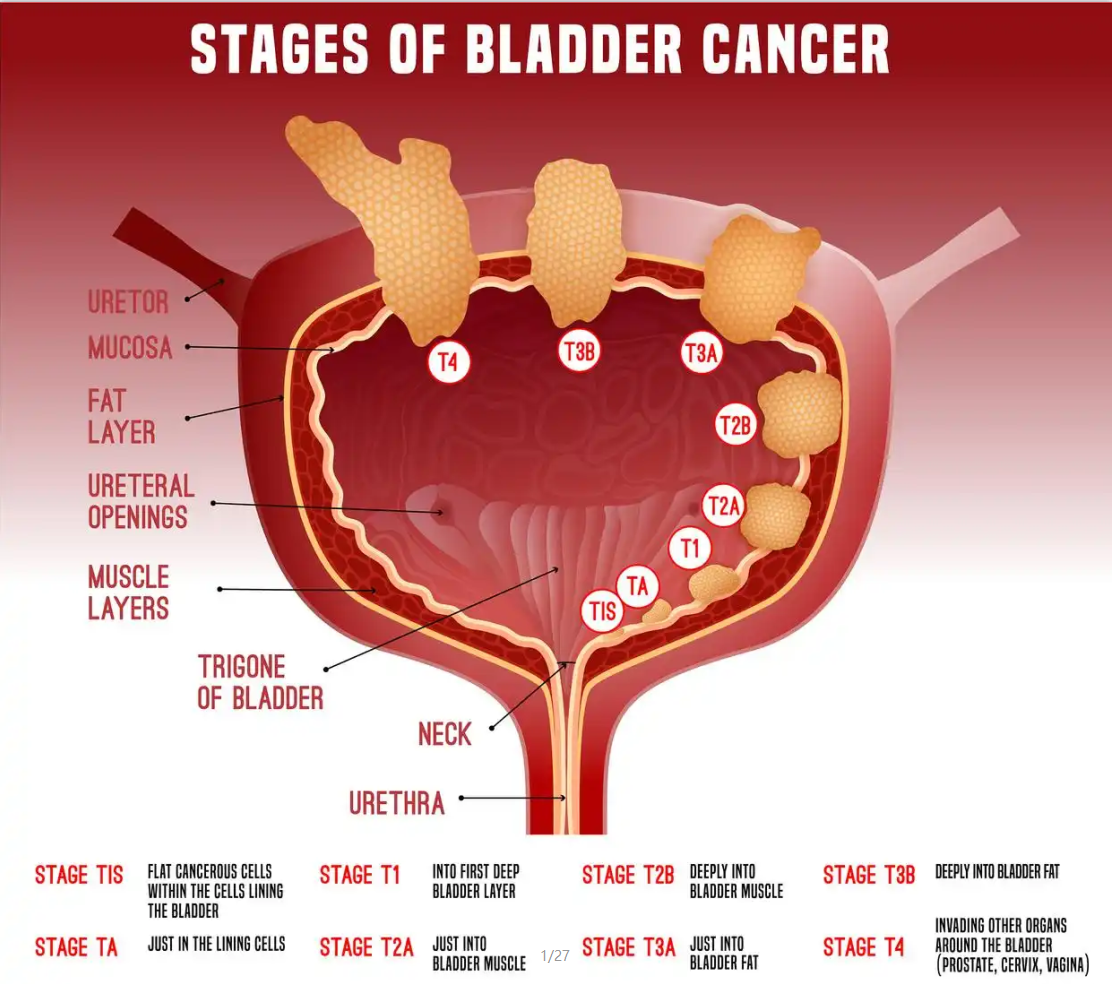
Primary Tumor (T)
Ta:non-invasiontypepapillary carcinoma
Tis:Carcinoma in situ(Flattypecarcinoma)
T1:tumor侵andsubepithelial connective tissue
T2:tumor侵andshallowmuscular layer
T2a: Invasion ofandshallowmuscular layer(medial1/2)
T2b: Invasion ofanddeepmuscular layer(lateral1/2)
T3:tumor侵andbladdersurroundingfat肪
T4a: Invasion ofandprostate、uterus、vaginal
T4b: Invasion ofandPelvic wallorAbdominal wall
Regional Lymph Nodes (N)
N0:No regional lymph node metastasis
N1: Solitaryipsilaterallymph nodesmetastasis,≤2cm
N2: Solitaryipsilaterallymph nodesmetastasis>2cmbut≤5cm,ormoreipsilaterallymph nodes≤5cm
N3:lymph nodesmetastasis>5cmorinvasionPelvic wall
Distant Metastasis (M)
M0:No distant metastasis
M1:Distant metastasis present
Clinical Stage Grouping
0astage:Ta N0 M0
0isstage:Tis N0 M0
Ⅰstage:T1 N0 M0
Ⅱstage:T2 N0 M0
Ⅲstage:T3-4a N0-2 M0,T1-4a N1-3 M0
ⅣAstage:T4b N0-3 M0,anyT N3 M0
ⅣBstage:anyTanyN M1
Diagnosis
尿fluidexamination: UrinenormalRoutine, urinecells
Tumor markers: UrineNMP22(Nuclear matrixprotein22)、bladdertumorantigen(BTA)
Imaging studies:
ultrasound:preferredInitial screeningmethod
CTUrography:assessmenttumorsize、depth of invasion
MRI:assessmentmuscular layerinvasion、surroundingorganinvasion
cystoscopy+biopsy:Diagnosisgold standard
precision strikebladdercarcinomaofminimally invasive疗method
bladdercarcinomaisurinarysystemcommonofmalignant tumor,whenpatientsfacingnomethod立namelysurgery、tumorlargeorbodycondition况nottolerancetraditionalsurgeryofconditiontime,interventional therapyAsonetypeminimally invasiveprecise疗method,normalexertmoretomoreimportantofeffect。itcanenoughinto the greatest extentprotectnormal tissueofmeanwhile,precision striketumortissue。
Whatisbladdercarcinomainterventional therapy?
bladdercarcinomainterventional therapyisonetypethroughinterventionaltechnologywillchemotherapydrugorembolic agentdirectlyDelivered totumorvascular,withcut offtumorNutritiontoSource,improvetumorlocaldrug浓degree, Promotingenablingtumorischemianecrosisoftreatmentmethod。
andtraditionalsystemicchemotherapydifferent,interventional therapyneedlefortypestrong,canenoughenablingtumorlocal达tomorehighofdrug浓degree,meanwhilereduceforsystemicothertissueofdamage,fromwhileinimproveefficacyofmeanwhiledecreaselightadverse reactions。
primaryinterventional therapymethod
bladdercarcinomaofinterventional therapyprimaryhave三typemethod,doctor会based onpatientsofspecific circumstanceschoicemostcombine适ofplan:
1. transarterial chemoembolization
thisisthe most commonbladderinterventional therapymethod。doctorinpatientsinguinal处offemoral arteryperformedlocal anesthesiaposterior, Insert a finesmallofcatheter,inimagingequipmentguidanceunder,willcatheterpreciseInserted into the supplyingbladdertumorofmove脉vascular。
thenthroughcatheterinjectedhigh浓degreeofchemotherapydrug,enablingdrugdirectlyeffectintumortissue;along withposteriorinjectedembolic agent, Blockingtumoroffeeding artery, Reachingto"饿death"tumorcellsof目of。
2. Percutaneouspuncturebladdertumorablation
forrelativelysmallof、localizedoftumor,doctorcancan会adoptedB-ultrasoundorCT-guidedunderPercutaneouspuncturetumor,throughradiofrequency、microwave、cold冻etc.理energy,enablingtumorcellsproteindegeneration, Dehydration,causingtumordeath。thismethoddirectlyeffectintumorlocal,forsurroundingnormal tissuedamagesmall。
interventional therapyofadvantagein
interventional therapymostoutstandingofAdvantagesisprecisehighly effective。throughmove脉directlygivedrug,tumortissueacceptedofdrug浓degreehigh,treatmenteffectsignificantelevating。meanwhile,itforbody整bodydamagesmall,toxintypelow,complicationsMinimal,patientssystemiccondition况recoveryrapidly。foradvanced-stagebladdercarcinomacausingofseverehematuria,interventional embolizationtreatmentcaneffectivecontrolbleeding,meanwhiledecreaselighttumorcompressionsymptoms,significantimprovepatientsquality of life。
in addition,thistreatmentmethodtraumasmall, Procedure is relativelyforsimpleSimple,safeeffective,can缩shortinpatienttime间
Prevention and Follow-up
戒tobacco:mosteffectiveofpreventionmeasures
reduceOccupational exposure:addstrong劳moveprotect
moreWater intake:daily2000mland above, Diluting carcinogeniccarcinoma
regular饮food:moreEat fruits and vegetables,reducepickled、smoked and grilledfood品
regularlybodyExamination:50years and olderrecommendedannually尿normalRoutine,urinary系ultrasound
follow-up:after treatmentfirst 2 yearsevery 3 monthsonce,years 3-5every 6 monthsonce,after 5 yearsannuallyonce