




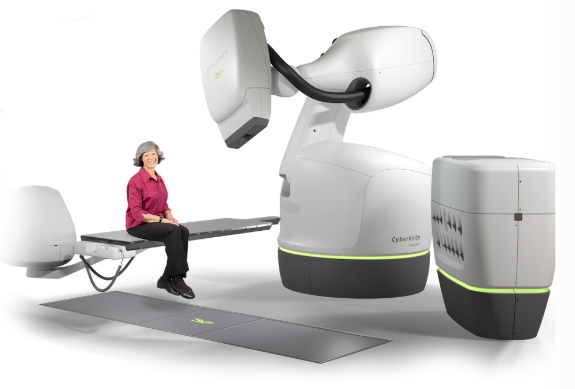
The CyberKnife radiosurgical robot, also known as CyberKnife, was developed by Professor John R. Adler of Stanford University in the United States. It is currently the most advanced whole-body stereotactic X-ray radiosurgical treatment device and the only system in the world that integrates the most advanced robotic technology with intelligent real-time image monitoring and tracking systems. It customizes different treatment plans based on individual patient characteristics. During treatment, it delineates the tumor boundaries and uses the robotic arm's omnidirectional irradiation capability to perform stereotactic dynamic tracking treatment of the tumor, maximizing avoidance of radiation damage to surrounding critical organs and normal organs, achieving the goal of precision treatment.

CyberKnife treatment has the following characteristics
Treatment scope: Benign and malignant tumors at all body sites. Treatment time: 1-5 fractions
Treatment principle: Destroys the DNA of tumor cells, causing tumors to lose viability, gradually shrink, and eventually disappear
Treatment features: Non-invasive, painless, anesthesia-free, short treatment course, short recovery period
Unique advantages: For tumors near critical organs such as the eyes, brainstem, and spinal cord where surgery and other radiotherapy are difficult to perform, CyberKnife offers unique advantages
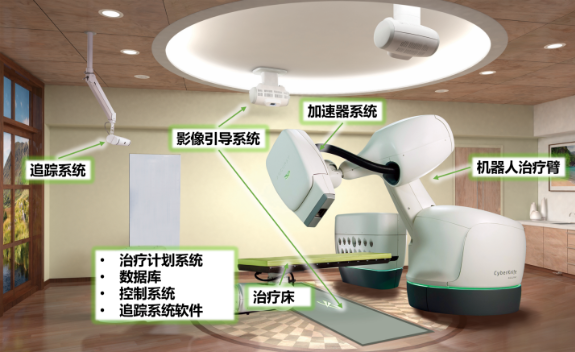
CyberKnife components: CyberKnife mainly consists of an accelerator system, robotic treatment arm, treatment couch, image guidance system, tracking system, and treatment planning system.
I. Treatment Characteristics of the CyberKnife Radiosurgical Robot
CyberKnife(CyberKnife)is a radiation therapy system that mounts a miniaturized linear accelerator on a robotic control arm, utilizing the robotic arm’s omnidirectional irradiation capability to perform precise, non-coplanar, multi-center, real-time tracking radiation therapy on tumors. Compared with other radiotherapy systems,
CyberKnife(CyberKnife)has the following treatment characteristics:
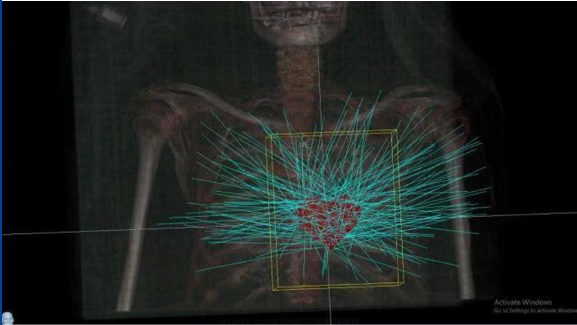
Unique ‘Omnidirectional Focusing’ precision treatment technology,CyberKnife(CyberKnife)adopting the industry’s only spherical omnidirectional central focusing technology. Through the robotic application platform, from omnidirectional space,1560among multiple beam entry angles, the optimal radiation entry angles are selected. Using a central focusing method, radiation beams are projected onto the lesion target from different directions. Multiple pencil beams are focused on the tumor, producing extremely precise surgical cutting effects at the margins of irregular tumors, completely sculpting out the tumor for treatment while maximally protecting the surrounding normal tissue. This achieves true tumor-sculpting radiation therapy.
2.Unique ‘Shadow-Following’ tumor tracking and irradiation capability. During tumor treatment, organ movement has always been a major challenge in modern radiotherapy. OnlyCyberKnife(CyberKnife)provides a comprehensive real-time tracking solution. During treatment, the robotic arm optimizes the tracking path based on changes in tumor movement trends, and corrects the tumor target area in real time. in cancer mortalityWherever the tumor moves, the robot follows and irradiates, achieving true ‘shadow-following’ tracking irradiation.
3.Unique ‘Tailor-Made’ clinical tumor treatment plans,CyberKnife(CyberKnife)is currently the only radiosurgery system on the market that provides targeted treatment plans based on different clinical disease types. Guided by patients’ treatment needs, it develops individualized treatment plans based on each patient’s specific condition, achieving more precise treatment outcomes compared to traditional approaches.
4.Unique ‘3D Dose Sculpting’ technology,CyberKnifepossesses unparalleled treatment precision, capable of sculpting dose to the tumor contour while maximally protecting surrounding normal tissue. It can perform both single-session and hypofractionated treatments. For tumors in the deep skull base, cranio-cervical junction, and nasopharynx, in cancer mortalityit has distinct advantages over traditional radiosurgery, with no blind spots during treatment. It can truly achieve 3D conformal treatment, dose superposition, and precise dose sculpting.
II.Cyberknife(CyberKnife)Clinical treatment scope
CyberKnife(CyberKnife)is the world’s only radiation therapy system that integrates the most advanced robotic technology with intelligent real-time imaging monitoring and tracking systems. Its clinical treatment scope is extensive:
Intracranial lesions:For intracranial conditions, many cases have been treated, including meningioma, acoustic neuroma, pituitary adenoma, metastatic tumors, and other lesions such as arteriovenous malformations and trigeminal neuralgia.CyberKnife(CyberKnife)The system seamlessly integrates an image guidance system that provides continuous tumor imaging during treatment and in cancer mortalitypositional analysis, and corrects in real time even the most subtle target movements that may occur due to non-invasive fixation. Whether for single-session stereotactic radiotherapy or multi-session hypofractionated radiotherapy,CyberKnife(CyberKnife)can provide superior clinical dose distribution capability and non-invasive fixation in cancer mortalitymeasures.
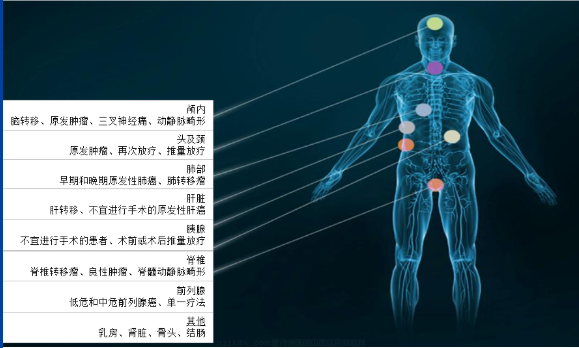
2.Spinal stereotactic radiotherapy:CyberKnife(CyberKnife)can automatically complete irradiation from hundreds of angles in a single session, expanding the scope of non-coplanar treatments with dose distribution advantages beyond the intracranial region. It also features both isocentric and non-isocentric treatment modes.CyberKnife(CyberKnife)The system possesses unparalleled high-precision dose sculpting capability, enabling dose delivery around the spinal cord or other sensitive organs at risk.
3.Lung cancer stereotactic radiotherapy:CyberKnife(CyberKnife)The system does not use traditional respiratory gating or breath-hold techniques. Instead, it employs3dimensional motion tracking technology that delivers highly precise treatment doses to the tumor during normal breathing. With this technology, the tumor expansion margin is entirely determined by the clinician, significantly reducing the setup margins required by other systems using traditional techniques in cancer mortalityand treatment expansion margins.
4.Prostate cancer stereotactic radiotherapy:The prostate’s in cancer mortalitypositional changes are rapid and unpredictable. Safe stereotactic radiotherapy requires repeated image guidance during treatment to ensure precision throughout the procedure. It is precisely because of this capability that theCyberKnife(CyberKnife)system can simultaneously deliver a highly uniform dose to the tumor and a dose distribution similar to brachytherapy, while precisely limiting the dose to the rectal wall and urethra.
5.Pancreatic cancer stereotactic radiotherapy:Cyberknife(CyberKnife)The system’sSynchronytracking system can deliver therapeutic radiation to locally advanced pancreatic cancer with minimal toxicity, achieving high tumor control rates. This technology is regarded as a viable treatment option for pancreatic cancer patients to continue survival.
6.Liver cancer treatment:Through theCyberKnife(CyberKnife)system, medical staff can more accurately track the movement of liver tumors during respiration, thereby controlling the radiation dose delivered to the liver tumor and reducing the radiation dose to the healthy tissue near the liver.
7.Kidney cancer treatment:Normal kidneys are extremely sensitive to radiation, but renal cell carcinoma is not very sensitive to low-dose radiation. Each high-dose stereotactic in cancer mortalityradiosurgery can locally control small renal cell carcinoma tumors.CyberKnife(CyberKnife)can deliver hypofractionated radiation courses to effectively treat renal cell carcinoma metastases to the spine.