
Liver cancer is known as the "silent killer" with hidden early symptoms; most patients are diagnosed at mid-to-late stages, losing the opportunity for surgery. In recent years, Yttrium-90 microsphere transarterial radioembolization (90Y-TARE), a minimally invasive interventional technique, has brought new hope to liver cancer patients. It is like a precisely deployed "internal nuclear bomb" that efficiently eliminates tumors with good efficacy, minimal trauma, and fast recovery, especially suitable for inoperable liver cancer patients.
I. How Do Yttrium-90 Microspheres Work?
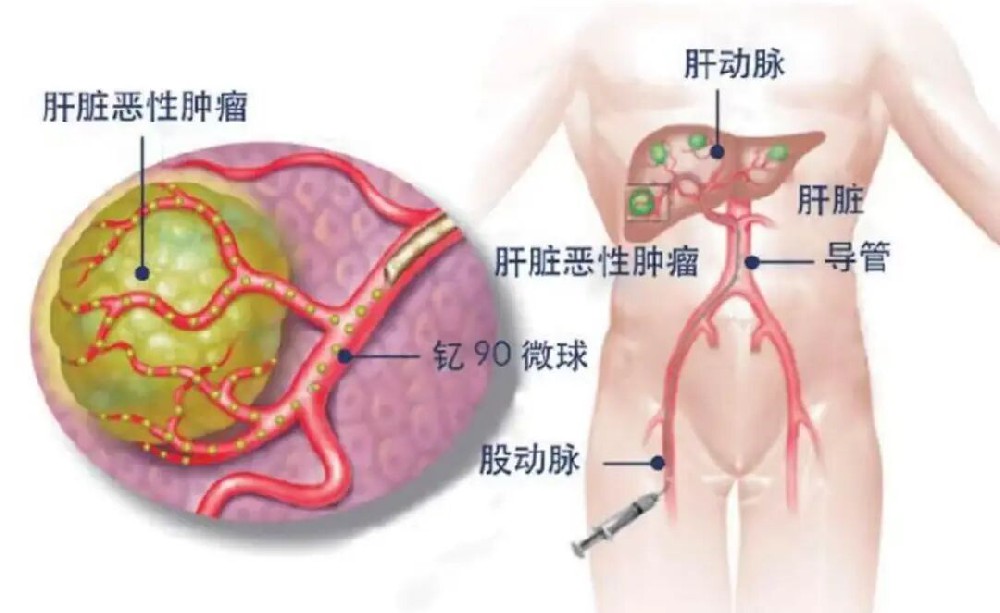
Yttrium-90 is a radioactive substance loaded on microspheres 20-60 micrometers in diameter (about 1/3 the thickness of a hair). Doctors use minimally invasive interventional techniques to precisely deliver microspheres through the hepatic artery to the tumor's blood vessels. The microspheres stay inside the tumor, releasing powerful beta rays to destroy cancer cells from within, achieving "internal radiotherapy." These rays have a very short range (averaging only 2.5mm), thoroughly killing tumors while maximally protecting surrounding healthy liver tissue.
Figure 1: Y-90 microsphere treatment diagram. Through minimally invasive interventional technology, Y-90 microspheres are directly delivered to the liver tumor site, providing high-dose radiation at close range to achieve tumor treatment.
II. What Are the Advantages of Y-90 Microsphere Treatment?
Precise and efficient: Microspheres reach the tumor interior directly, with radiation doses 2x or more than traditional radiotherapy, with significant tumor shrinkage.
Minimally invasive and safe: Treatment takes only 1-2 hours, no surgery or hair loss, with rapid post-operative recovery.
Dual effect: While eliminating tumors, it promotes healthy liver tissue regeneration, creating opportunities for subsequent surgery.
Few side effects: Post-operative discomfort is usually brief and mild (such as abdominal distension and fatigue); serious complications are rare.
III. Which Patients Are Suitable for Y-90 Treatment?
Hepatocellular carcinoma: including curative treatment of early-stage, tumor shrinkage for mid-stage to enable surgery, prolonged survival and symptom relief for late-stage, and bridging treatment for liver transplant patients; Additionally, alsosuitablefor conventional treatment(如chemotherapyembolization, perfusionchemotherapy、ablation, anti-cancer drugs,surgery, etc.Treatment Outcomessuboptimal or for follow-up patients.
Intrahepatic cholangiocarcinoma: especially when disease progresses despite systemic chemotherapy, with tumors mainly concentrated in the liver and acceptable liver function.
Hepatic metastases: such as colorectal cancer, neuroendocrinetumor, breast cancer, etc., etc.with liverand metastasis, andand metastasislesions are relatively localized and other treatments are difficult to controlconditions。

IV. What to Prepare Before Treatment?
comprehensiveassessment:includingBlood tests including complete blood count, liver and kidney function, coagulation function, etc.,andCT/MRI, etc.Imaging examination to determinetumorcondition.
Simulation test(pre-operativeMapping): Before treatment, a liverangiography and protective when necessaryembolization;then a simulation injection is performed(99mTc‑MAA), through imagingassessmentmicrospheresafterdistribution in the body, ensuring the doseprecision、safe。
multidisciplinaryconsultation:interventionaldepartment, nuclear medicine, hepatobiliary surgery,tumorinternal medicine, etc.multidisciplinaryexpertA total ofjoint discussion, forpatientsdevelopingindividualizedplan。
Note: Allpatientsmust undergo strictassessment, ensuring treatmentsafeeffective。
V. What Is the Treatment Process Like?
Local anesthesia:patientsThe patient remains conscious, no general anesthesia required.
catheterCatheter insertion: Through the groin areaarterypuncture, the thincatheteris guided to the livertumor的feeding artery。
microspheresInjection:afterReal-time imagingguidance,guides the yttrium-90microspheresprecisioninjection intotumorarea, the process takes about1hours.
Hemostasis after completion: After treatment, the catheter is removedcatheterand thepuncturesite is bandaged.
VI. After Treatment, Will There BeWhichresponse?
Commonresponse: mild fatigue,abdominal painor low-grade fever, most resolve on their own.
Seriouscomplications: rare, through strictpre-operativeassessmentand careful intraoperative technique can beeffectiveprevented.
radiationsafe: Yttrium-90afterdecays rapidly in the body,2after weeksradiation已basicallydisappears. Avoid short-term post-treatment and close contact with pregnant women and young children; no long-term isolation needed.
VII.efficacy and safeEfficacy?
For some early-stageliver cancercan achieve radical cure.
For mid-stageliver cancer可effectiveshrinkingtumor, increasing residual liver volume, creatingsurgical resectioncreatingopportunity。
For advanced-stageliver cancercan controltumor and 门veintumor thrombus, prolongingpatientssurvival time.
globalApplications have exceeded15ten thousand cases,safewith high safety profile, overall adverseresponselower thantraditional treatment。